
And listen… we love a smart investment.
But when it comes to the cost of senior living paid search, lower-cost management is usually where good budgets go to get wasted.
This is not about protecting agency pricing. It is about protecting your community’s occupancy goals.
Because… when a senior living operator or management company is spending money on paid search, the real question is not, “What is the cheapest way to run ads?” It is, “What is the smartest way to turn search demand into qualified inquiries, tours, and move-ins?”
Those are very different questions.
For senior living communities, paid search management has to account for local competition, high-intent family decision-making, call tracking, sales attribution, landing page alignment, and lead quality across multiple touchpoints.
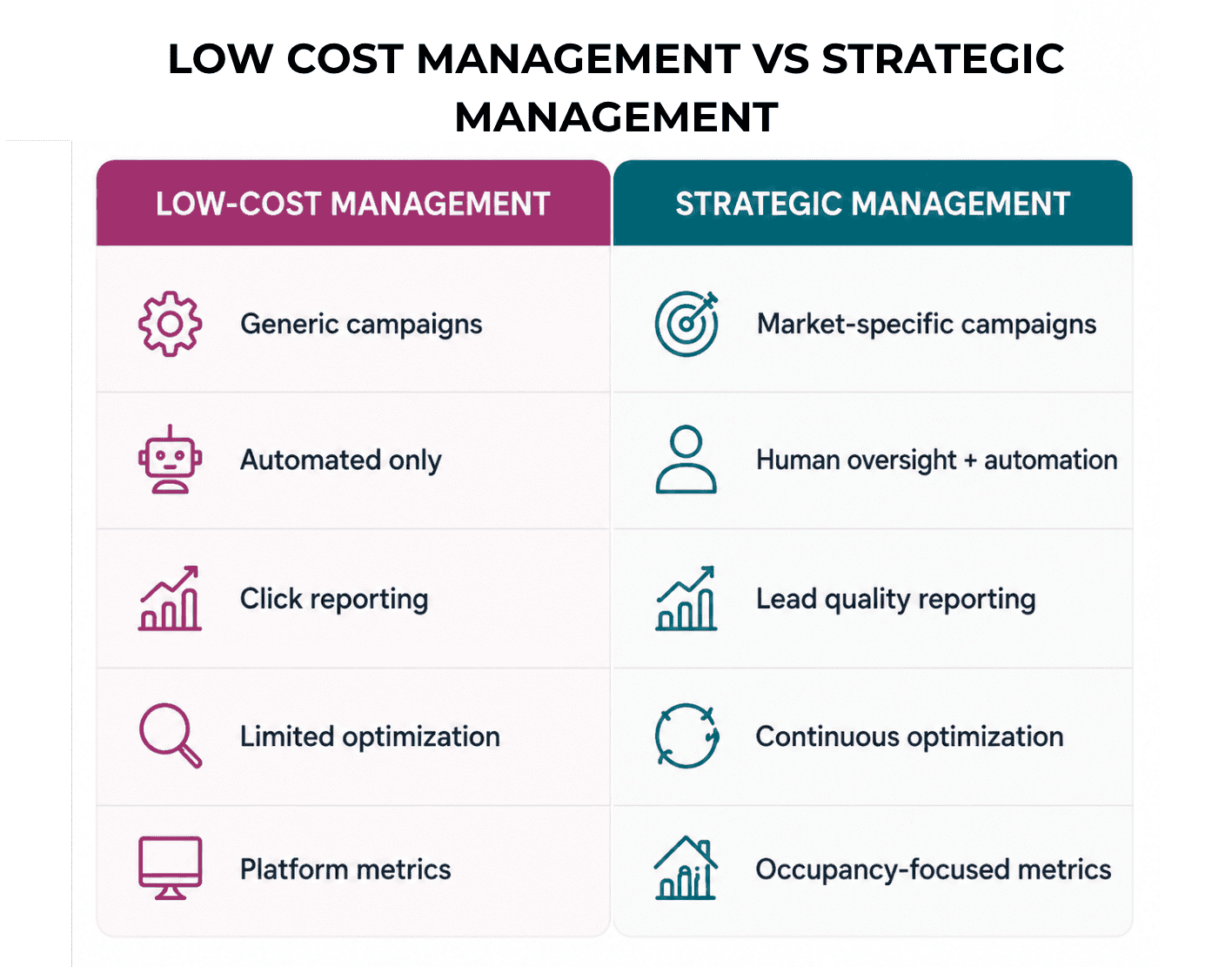
If that strategy is missing, your dashboard may look busy while your sales team is still asking where the qualified leads are. That means that low-cost management is probably the result of using templated campaigns, limited hands-on human optimization, weak reporting on vanity metrics, and little connection between ad activity and actual business outcomes.
In this article we are going to breakdown the real cost of a smart paid search strategy for senior living operators. Specifically, we will answer the following:
- What Does a Low Monthly Management Fee Actually Buy You?
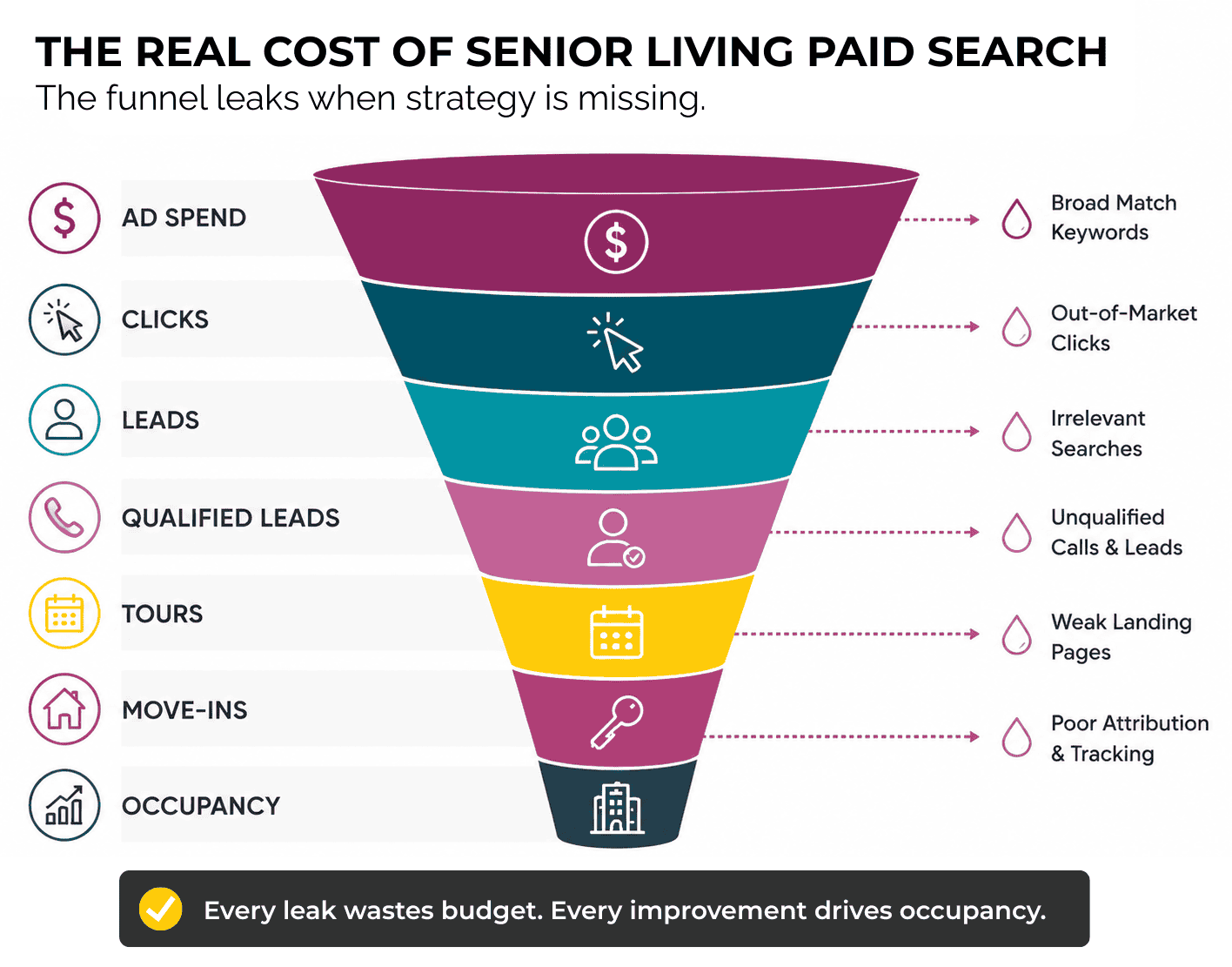
- Where Are Paid Search Budgets Wasted in Senior Living?
- Why Does This Hit Harder in Senior Living Than in Other Industries?
- When Does “Set It and Forget It” Get Pricey? (The Automation Trap)
- What Does Quality Senior Living Paid Search Management Include?
- What Is a Recommended Google Ads Budget for Senior Living Communities?
- What Is The Difference in Management Fees: Flat Rate vs. Percentage of Ad Spend?
- Why Does Fee Structure Matter Even More for Portfolios?
- What Questions Do I Need to Ask Before Hiring a Senior Living Paid Search Partner?
- What Can A Better Strategy Actually Change? (A real senior living example)
- What Is The Real Cost of Cheap Paid Search Management?
- Plus…More FAQs
An agency charging a very low monthly fee has to make the math work somewhere, and that usually means one account manager is overseeing way too many accounts. In that model, there is not enough time to:
- Review search terms regularly
- Build and maintain negative keyword lists
- Adjust campaigns by market
- Refine audience signals
- Monitor lead quality
- Coordinate with your website, CRM, or call tracking setup
- Think strategically about how one community differs from another
And in senior living, that last part matters. A lot.
Paid search for an independent living community in a competitive suburban market is not the same as paid search for memory care in a dense metro. A single-site operator trying to build local visibility does not have the same needs as a regional operator managing ten communities across multiple service lines.
Low-cost management usually leads to one-size-fits-all campaign setups, overreliance on automation, and reporting that tells you how many clicks happened without telling you whether any of those clicks were actually worth paying for. That risk is exactly the kind of “smart strategy grounded in proven results” SGD’s brand positioning pushes against.
Where Senior Living Paid Search Budgets Are Commonly Wasted
In senior living, wasted ad spend often hides inside broad targeting, poor keyword control, weak conversion tracking, and campaigns that are optimized for volume instead of qualified intent.
- traffic from people searching for jobs instead of care options
- clicks from users outside your geographic market
- broad-match queries that have nothing to do with your level of care
- campaigns sending all traffic to a generic website page instead of a conversion-focused landing page
- calls being counted, but not qualified
- form submissions showing up as leads even when they are not move-in relevant
And because senior living is a longer-consideration purchase with multiple
Now instead of helping families who are actually exploring senior living options, your team is wasting time sorting through junk leads, duplicate inquiries, and low-intent activity that never should have made it through the funnel in the first place.
That is not efficient. That is expensive with better branding.
Why This Hits Harder in Senior Living Than in Other Industries
You are not selling an impulse purchase. You are trying to connect with:
- adult children researching on behalf of a parent
- older adults exploring options on their own timeline
- families comparing independent living, assisted living, and memory care
- local searchers who may be early in research or ready to schedule a tour now
That means the cost of senior living paid search is not just measured in dollars spent. It is measured in what happens after the click.
If the keyword strategy is messy, if the landing page is vague, if the conversion tracking is broken, or if your campaigns are not aligned to service line and geography, your budget starts leaking fast.
And yes, Google will still happily spend it.
The Automation Trap: When “Set It and Forget It” Gets Pricey
That is a big difference.
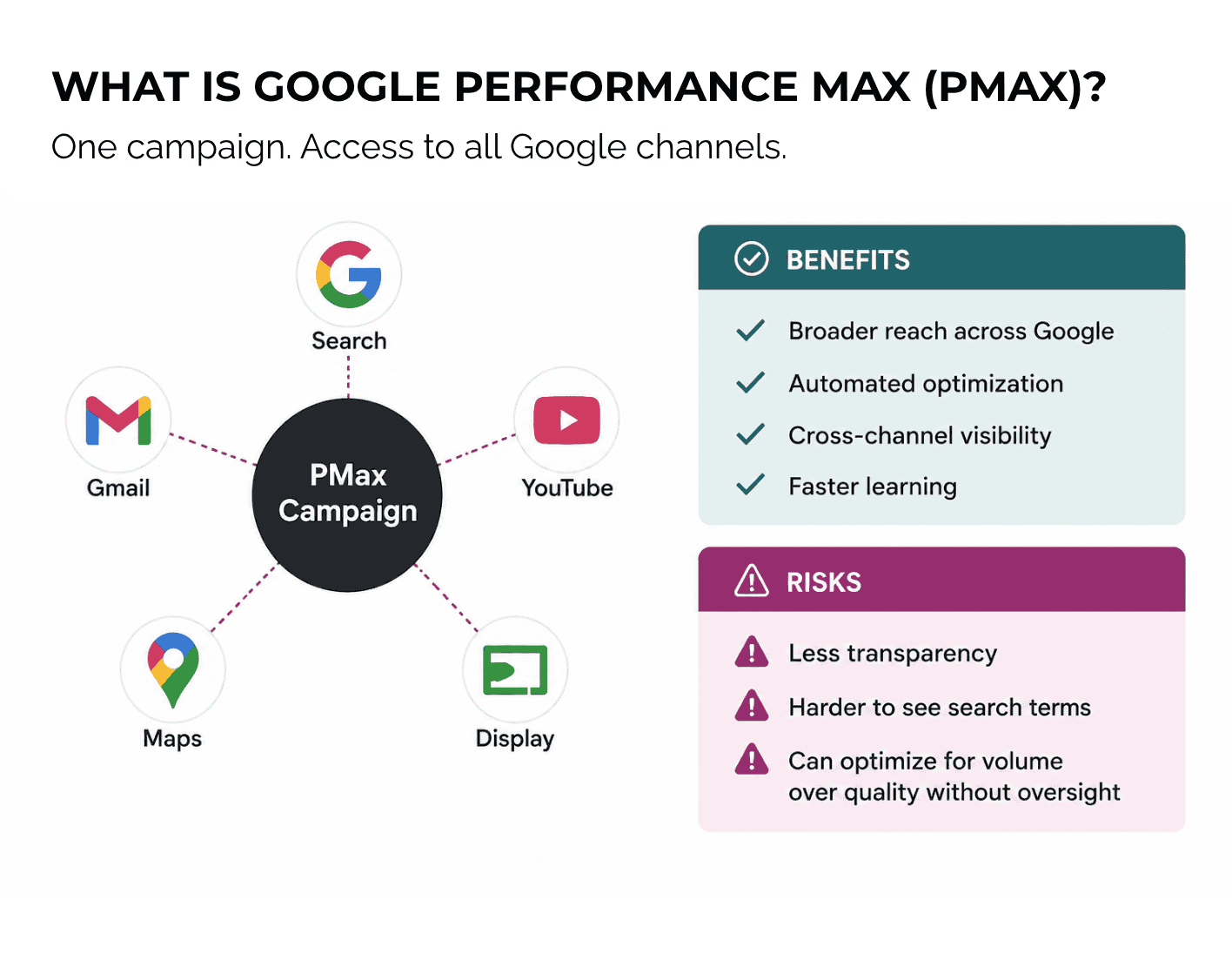
Performance Max, broad match, automated bidding, and recommendation-driven campaign changes can all be useful when they are supported by:
- clean conversion tracking
- reliable first-party data
- strong landing page alignment
- audience signals
- active oversight from someone who knows what they are doing
Without that foundation, automation can optimize toward the wrong outcome. A Performance Max campaign may generate more conversions according to Google’s reporting, but if those conversions are job seekers, unqualified calls, duplicate inquiries, or low-intent form fills, the campaign may appear successful while creating more work for your sales team. Automation is only as effective as the data and strategy guiding it.
And in senior living, platform-reported conversions are not enough. You need to know whether those clicks turned into real calls, qualified inquiries, tours, and eventually move-ins.
That kind of judgment is not built into a bargain management package. It comes from experience, oversight, and strategy.
What Should Be Included in Senior Living Paid Search Management
For senior living communities, real management should include:
- keyword strategy built around service line and buyer intent
- location-specific targeting
- negative keyword development and ongoing cleanup
- landing page alignment by audience and offer
- conversion tracking for calls, forms, and meaningful next steps
- regular search query reviews
- ad testing based on performance, not guesswork
- clear reporting tied to lead quality and business outcomes
- coordination with sales and marketing systems where possible
This is especially important for operators managing multiple communities. Portfolio strategy should still allow for market-level nuance. A community in one region may need a very different paid search approach than a sister property in another.
That is why templated management often underperforms in senior living. Your communities may share a brand umbrella, but they do not all share the same competitive reality.
What Is a Recommended Google Ads Budget for Senior Living Communities?
The right Google Ads budget depends on:
- how many communities you are promoting
- which service lines you are advertising
- the competitiveness of each market
- your occupancy goals
- your current website and landing page conversion rates
- whether you are trying to maintain visibility or actively scale lead volume
That said, there are a few practical ways to think about it.
For a Single Community
A single senior living community usually needs enough budget to gather meaningful data, compete in its local market, and support ongoing optimization. If the budget is too low, campaigns may never generate enough volume to learn, improve, or consistently drive qualified leads.
For one location, your budget should be high enough to support:
- branded search coverage
- high-intent non-branded search terms
- local geographic targeting
- conversion-focused landing page traffic
- enough lead volume to evaluate quality, not just quantity
For Regional Operators or Small Portfolios
For management companies and multi-location operators, budget planning needs to occur at both the portfolio and market levels.
Not every community needs the same spend. Some markets will be more competitive. Some communities may have stronger organic visibility and need less paid support. Others may need a stronger push because they are newer, offer a more niche care offering, or operate in a crowded local market.
A smart portfolio strategy often includes:
- a base level of market visibility per community
- heavier investment in priority communities
- service-line-specific campaigns where needed
- centralized oversight with local performance adjustments
The right question is not, “What is the lowest budget we can get away with?”
It is, “What budget gives us a realistic chance to compete, collect useful data, and generate qualified senior living leads?”
Because underfunded paid search campaigns do not usually save money. They just produce weaker results more slowly.
And for senior living operators, investors, and leadership teams, that is the bigger point… paid search should not be evaluated only by clicks, form fills, or cost per lead in isolation. It should be connected to the business metrics that matter most … occupancy and NOI.
More qualified leads should support more tours. Better tours should support more move-ins. More move-ins should support stronger occupancy. And stronger occupancy has a direct impact on revenue performance and ultimately net operating income.
That is why paid search budgets should be treated as part of a larger growth strategy, not just a line item to minimize. If your paid search efforts are not contributing to occupancy goals and supporting the financial performance operators and investors are watching, then the budget is not working hard enough.
The Difference in Management Fees: Flat Rate vs. Percentage of Ad Spend
There are two common pricing models for paid search management:
Flat-Rate Management Fee
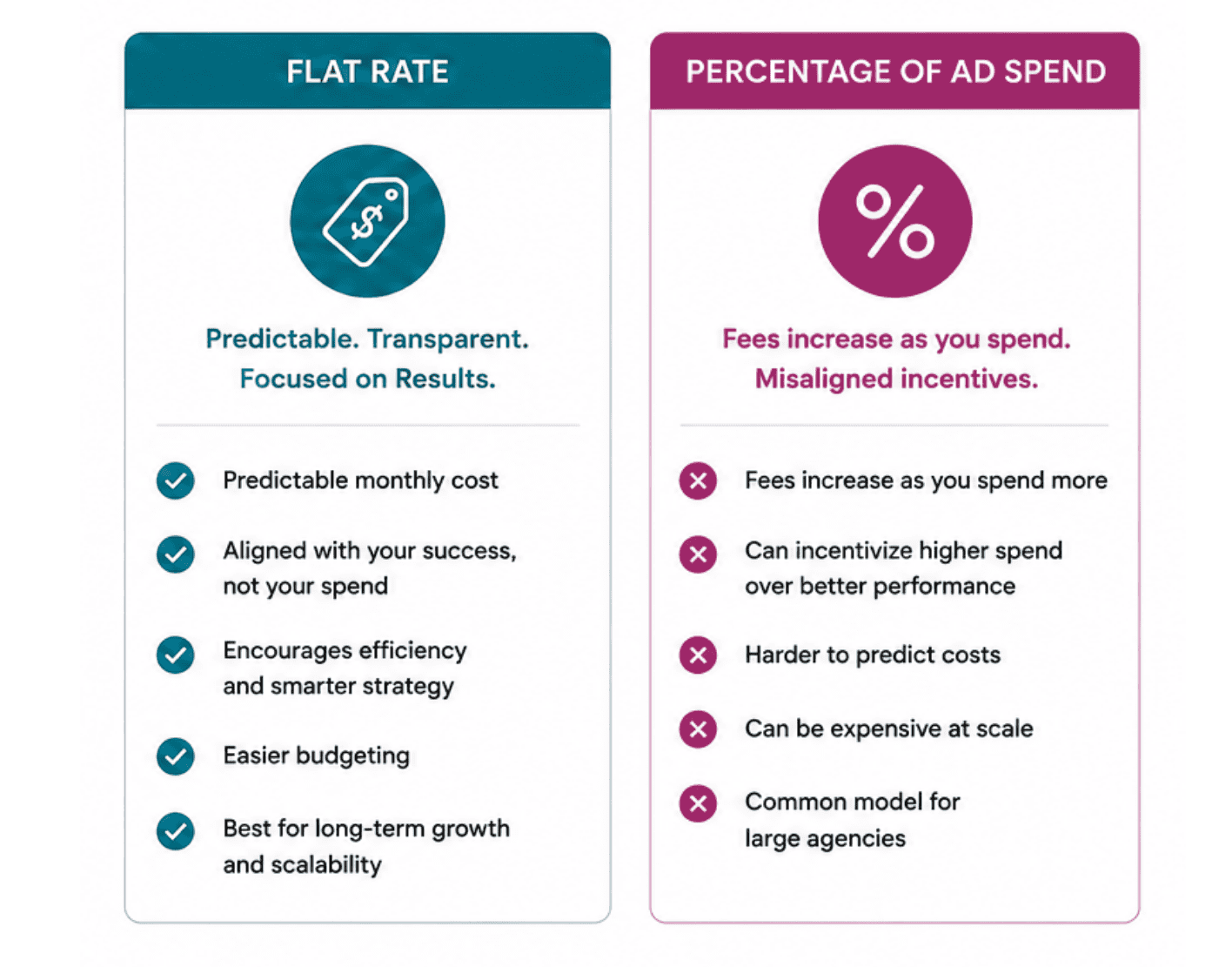
This is a consistent monthly fee for the management work itself.
Why this model can be a strong fit for senior living:
- easier budget forecasting for operators and regional teams
- cleaner separation between media spend and management costs
- better alignment with strategic work, not just bigger ad budgets
- especially helpful for communities or portfolios with seasonal shifts, occupancy pushes, or changing spend priorities
And yes, we like that.
Percentage of Ad Spend
This model charges a management fee based on a percentage of your monthly ad spend.
It is common in paid media. It is not automatically bad. But it can get messy if it is not paired with strong accountability.
Where this model can create tension:
- as ad spend rises, management fees rise too
- higher spend does not always equal more strategic work
- it can blur the line between scaling efficiently and simply spending more
- multi-location portfolios can end up paying significantly more in management fees without a proportional increase in strategic attention
For large operators with complex accounts, percentage-based fees may be presented as standard. Sometimes they make sense. But in senior living, where operators are balancing occupancy pressure, budget scrutiny, and location-level performance differences, a flat-rate model often gives leadership more clarity and control.
So no, percentage-of-spend pricing is not inherently wrong. But if you want your agency relationship to feel like a strategic partnership instead of a spend escalator, flat-rate management is often the smarter structure.
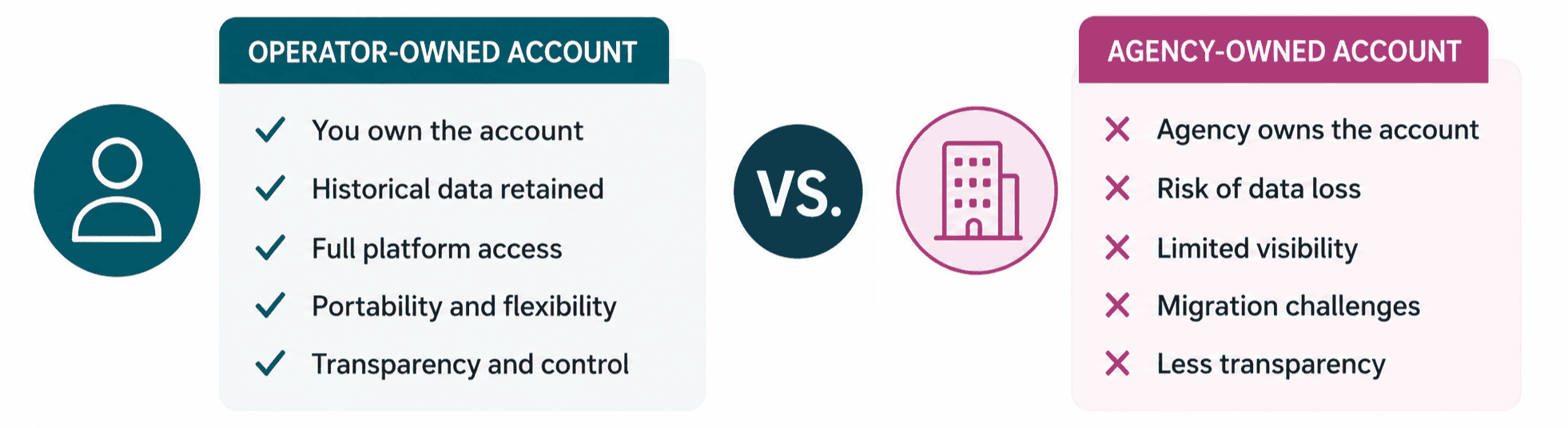
Caution: Operators should be paying Google, Microsoft, Meta, or any ad platform directly for media spend. If your agency is invoicing you for ad spend instead of having you fund the platform directly, that can be a red flag. In some cases, it points to ownership and access issues with the ad account … and that can become a much bigger problem if you ever want visibility, portability, or control over your campaign history.
Why Fee Structure Matters Even More for Portfolios
A single-site operator and a regional management company should not necessarily pay the same way, because the scope is different. But the structure still needs to make sense.
With a portfolio, your management fee should reflect real complexity such as:
- number of markets
- number of service lines
- number of campaigns or landing pages
- reporting expectations
- tracking and attribution setup
- level of strategic oversight required across locations
What you do not want is a pricing model where management fees balloon simply because total media spend increased, even if the day-to-day strategic work did not change at the same pace.
That is one reason flat-rate or tiered flat-rate pricing can be more appealing for senior living portfolios. It gives operators more predictability, especially when they need to shift spend between communities or support different occupancy goals throughout the year.
The #1 Question More Senior Living Operators Should Ask
You should.
Your organization should have full ownership of its ad account, conversion history, campaign structure, and performance data. If an agency builds everything under their account and you leave, you should not have to start from scratch just because the relationship changed.
In senior living, where optimization compounds over time and local market learning matters, losing that history is not just inconvenient. It is costly.
Get account ownership in writing. No wiggle room.
What to Ask Before Hiring a Senior Living Paid Search Partner
How many accounts does each strategist manage?
Because “hands-on” and “spread too thin” are not the same thing.
How do you measure success?
If the answer is mostly impressions, clicks, or platform conversions, keep digging.
How do you evaluate lead quality?
Senior living paid search should connect back to actual inquiry quality, not just form volume.
What experience do you have in senior living?
This space has different decision cycles, different urgency triggers, and different conversion behaviors than most other industries.
How do you price your management fees?
Ask whether they use flat rate, percentage of spend, or a hybrid model … and ask why.
Who owns the account and the data?
Non-negotiable.
A Senior Living Example: What Better Strategy Can Actually Change
Before Smart Girl Digital stepped in, Ring House was dealing with low visibility, weak attribution, unqualified traffic, and a digital setup that was splitting performance between an outdated microsite and the main domain. The result was unclear reporting, wasted spend, and limited visibility into what was actually driving qualified interest.
Once SGD rebuilt the digital foundation, aligned SEO and paid search, improved tracking, and implemented more intentional campaign strategy, Ring House saw measurable improvement. According to the approved case study:
- monthly sessions increased from 6,568 to 8,164
- page one keyword rankings grew from 18 to 111
- paid search achieved a 2.77% click-through rate
- landing page conversion rate reached 3.43%
- cost per conversion came in at $91.82
- the community generated 87 calls in June 2025, with 22 qualified leads
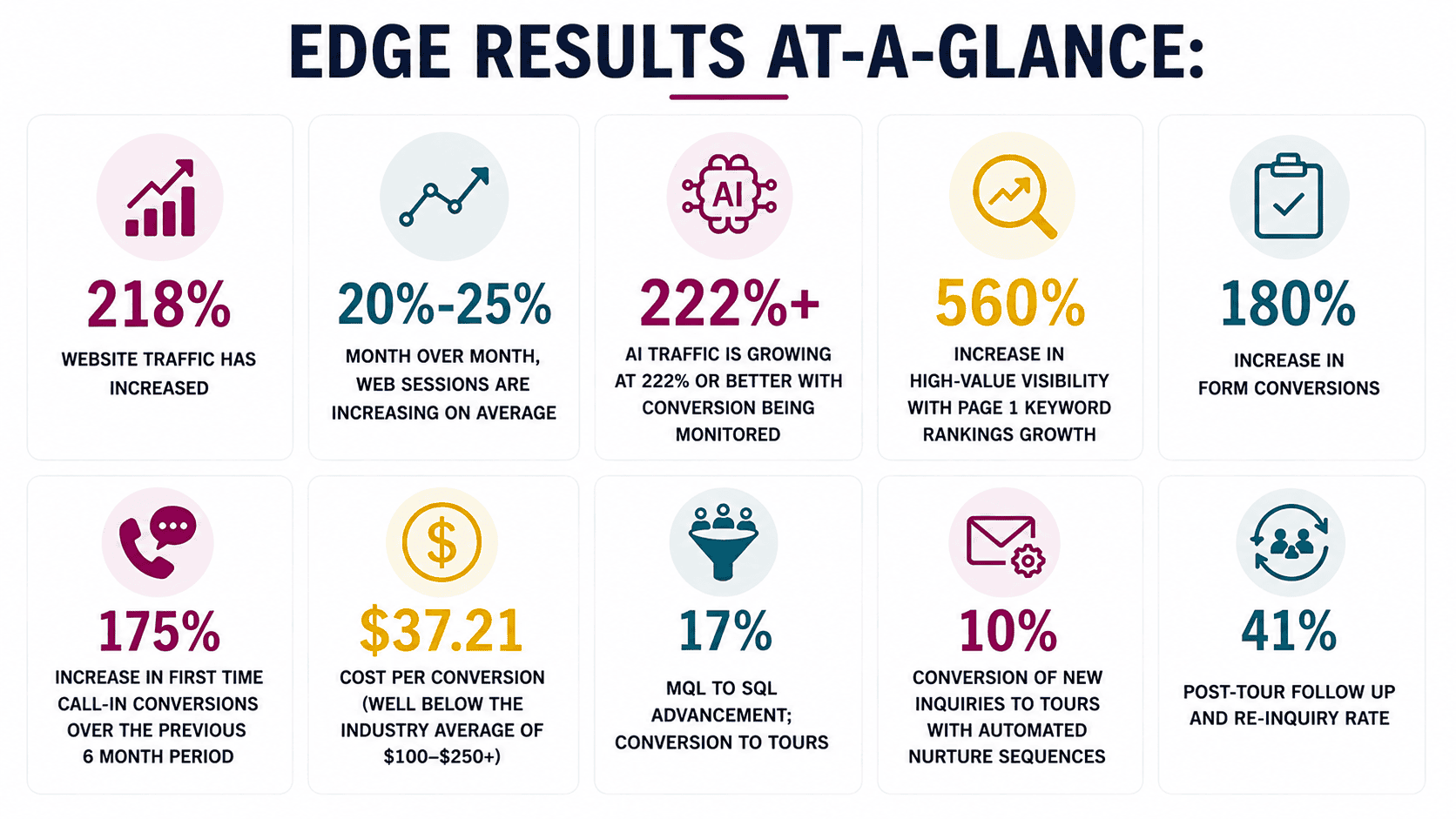
That is the difference between paying for clicks and investing in a system.
The Real Cost of Cheap Paid Search Management
It is just harder to spot on a spreadsheet.
The cost of senior living paid search is not just your monthly media spend. It is the total cost of poor strategy, weak oversight, missed attribution, underqualified leads, and occupancy opportunities that never made it past the search results page.
That is why smart paid search management is not about doing more. It is about doing the right things, with the right structure, for the right communities.
And that is exactly where a smarter setup can change the game.
If your team is trying to figure out whether your current Google Ads strategy is built for qualified senior living growth … or just built to keep campaigns running … it may be time for a closer look.
Want a smarter starting point?
Learn more about Smart Girl Digital’s Google Jumpstart package and book a discovery call to talk through what your paid search strategy should actually be doing for your communities.