Every few years, someone declares email marketing dead.
Social media was supposed to replace it. Then texting. Then chatbots. Now AI.
And yet…here we are, still checking our inboxes.
For senior living marketers, email remains an important part of the customer journey. In a survey of 99 senior living professionals conducted by Senior Housing News and Dreamscape Marketing, 80% of respondents identified email marketing as a top marketing tool. Marketing automation was also an area of focus for 28% of respondents.
Meanwhile, the audience itself is becoming increasingly digital. AARP’s 2026 technology research found that 90% of adults age 50+ own a smartphone, and older adults now use an average of 14 digital services and 10 different apps within a three-month period.
So, is email marketing dead?
No.
But the days of sending the same generic email to your entire database and calling it a strategy probably should be.
Today’s best email marketing is more personalized, more intentional and more connected to the customer journey. And that is where marketing automation becomes especially powerful.
Senior living is not an impulse purchase.
Prospective residents and their families may spend months researching options, comparing communities, discussing finances, talking with siblings and deciding whether they are emotionally ready to make a move.
That creates a very different marketing challenge than simply generating a lead.
You have to stay relevant while the prospect works through the decision.
Recent senior living data reinforces how much the research process is changing. Aline’s 2026 Senior Living Sales & Marketing Benchmark Report, which includes insights from more than 95,000 active senior living researchers in 2025, found that older adults now represent a majority of those initiating the senior living research process. The report also notes that families are beginning their research earlier and arriving with more context.
That makes email particularly valuable because it gives senior living organizations a way to maintain the relationship after that initial inquiry.
A prospect may not be ready to schedule a tour today. But they might be ready to read an article about downsizing, understand the difference between assisted living and independent living, attend an educational event or learn what questions to ask when comparing communities.
Good email marketing keeps your community present during those moments.
And unlike an audience on Facebook, Instagram or another third-party platform, your email database is a first-party audience your organization can continue building relationships with over time.
Email works best when it’s part of a larger, connected strategy. Our blog post, “Senior Living Marketing Strategy: An Ecosystem Framework to Attract, Nurture, and Convert the Right Leads” breaks down how your channels, content, technology, and sales process can work together across the full customer journey.
Email Marketing vs. Marketing Automation: What’s the Difference?
Email marketing and marketing automation are often used interchangeably, but they aren’t exactly the same thing.
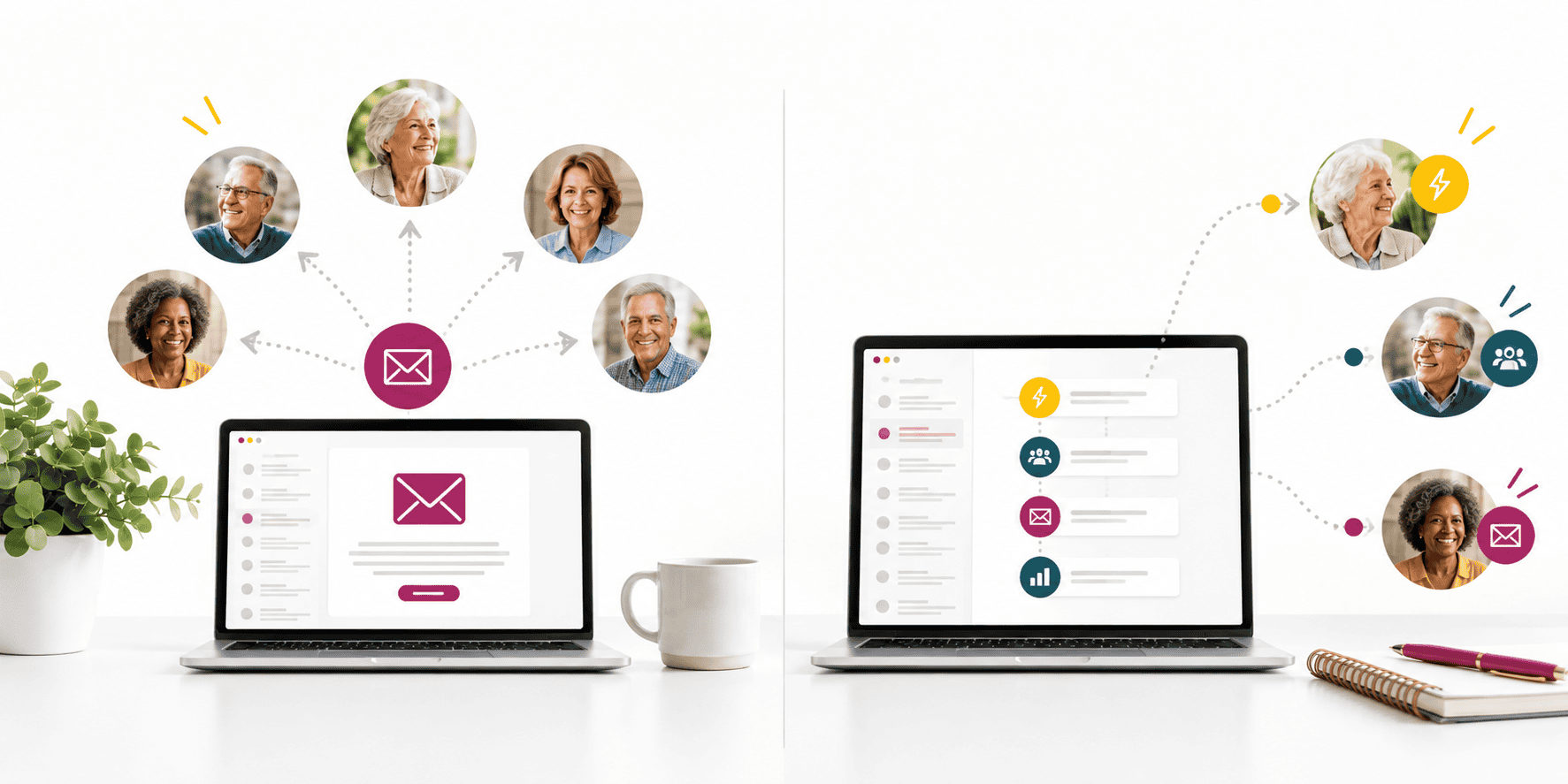
Email marketing is the channel. Marketing automation is the system behind it.
Traditional email marketing might look like this:
Your marketing team creates a newsletter, selects a list, schedules it for Thursday and sends it.
Marketing automation goes further.
Instead of deciding that everyone should receive Email A on Thursday, automation allows your marketing technology to determine what communication someone should receive based on who they are, where they are in the customer journey and what they have already done.
Imagine a prospect downloads a pricing guide from your website.
That action could automatically trigger a welcome email. If they click through to view independent living floor plans, the system could send relevant independent living content. If they later schedule a tour, the original nurture campaign could stop and a post-tour sequence could begin.
That is customer journey automation.
The goal is not to send more email.
The goal is to send more relevant email.
What Are the Benefits of Marketing Automation?
One of the biggest advantages of marketing automation is consistency in delivering the right message, at the right time..
Your sales team may fully intend to follow up with every prospect three, four or five times. But senior living sales teams are juggling tours, move-ins, family conversations, events, CRM updates, and dozens of other priorities.
Automation can help make sure the nurture does not disappear when things get busy.
And continued follow-up matters…
Aline’s analysis of data from more than 9,300 senior living communities found that it can take three to four follow-up touches to secure a response from a prospect.
Marketing automation can support those additional touches without requiring a sales counselor to manually create every single one.
It can also improve speed-to-lead. An inquiry can immediately receive confirmation and useful information instead of waiting until someone is back at their desk.
It can create better segmentation by allowing content to change based on care type, lifecycle stage, community, engagement or other known information.
It can improve sales and marketing alignment by automatically notifying sales when a prospect takes a high-intent action.
And it can make longer-term nurturing far more manageable.
That last point is especially important in senior living.
Senior Housing News reported in 2025 that Beztak’s average inquiry-to-move-in sales cycle had been 204 days for independent living and 114 days for memory care in 2022. By 2024, the organization had reduced those averages to 154 and 83 days respectively, with email campaigns among the strategies used to re-engage leads.
A lead that is not ready this week is not necessarily a bad lead.
Sometimes they just need more time.
7 Email Marketing Best Practices for Senior Living
Email marketing still works.
But good email marketing looks very different from uploading one giant list and pressing send.
Here are seven email marketing best practices senior living teams should keep top of mind.
1. Segment Your Audience Before You Hit Send
Why is segmentation important in email marketing?
Because your database is not one audience.
An adult daughter researching memory care for her mother has very different questions than a healthy 74-year-old beginning to explore independent living.
Someone who toured yesterday is in a very different place than someone who downloaded a guide six months ago.
And a professional referral partner probably does not need the same newsletter as a prospective resident.
Segmentation allows you to create groups based on factors such as lifecycle stage, care level, location, prospect type, interests and previous engagement.
Your segments might include new inquiries, independent living prospects, memory care families, toured prospects, event attendees, long-term nurture prospects, professional referral partners and cold or disengaged leads.
The more useful data you collect, the more relevant your emails can become.
But here is the important part:
Segmentation is not personalization just because you added {First Name}.
True personalization means changing the communication based on what you know about the prospect and what would actually be useful to them.
That is where segmentation and automation work beautifully together.
Segmentation determines who needs the message. Automation determines when they should receive it.
2. Stop Looking for the Perfect Email Frequency
How often should you send email marketing?
There is no universal magic number. Think about quality over quantity.
Once a week might be perfect for one audience and incredibly annoying for another.
Instead of asking, “How many emails should we send every month?” start asking:
“What does this prospect need from us right now?”
A person who requested pricing today may appropriately receive several communications within their first week.
Someone who attended an educational webinar but indicated they are planning two years ahead probably needs a slower nurture cadence.
A prospect who toured yesterday may benefit from timely post-tour follow-up.
A database of long-term prospects might receive a useful monthly newsletter and occasional event invitations.
Your email sequence should follow the customer journey rather than an arbitrary marketing calendar.
This is also why behavioral or event-triggered marketing can outperform a one-size-fits-all drip.
A prospect does something.
Your marketing responds appropriately.
Simple.
3. Keep Marketing Emails Focused
How long should a marketing email be?
Make your email as long as it needs to be to accomplish one primary objective, and not much longer.
Senior living marketers sometimes try to squeeze five messages, four announcements, three events and seven calls-to-action into one email.
Technically, you communicated everything.
Strategically? You may have communicated nothing.
Give the reader a clear hierarchy. Keep paragraphs easy to scan. Use descriptive headings when appropriate. Make links and buttons easy to identify. And remember that much of your audience will be reading on a phone.
That consideration is increasingly important for older consumers. AARP reports that smartphone ownership among adults 50+ reached 90% in 2025. AARP
Clarity wins.
4. Write a Subject Line That Gives People a Reason to Open
How do you write a good subject line for an email?
Start with relevance.
A clever subject line cannot save an email your audience does not care about.
Strong subject lines tend to clearly communicate value, spark appropriate curiosity or connect directly to something the recipient is already thinking about.
Compare:
March Newsletter
with:
5 Questions to Ask Before Touring a Senior Living Community
The second gives the reader a reason to pay attention.
Avoid exaggerated clickbait or urgency you cannot back up. Trust matters enormously in senior living, and the subject line is part of that experience.
Your email preheader matters too. Think of it as supporting copy for the subject line instead of leaving it populated with “View this email in your browser” or the first random sentence from your template.
And test.
Different audiences respond differently. A/B testing subject lines can help you understand whether your database responds more strongly to questions, educational value, direct invitations, urgency or other messaging approaches.
5. Build Automated Triggers Around the Customer Journey
This is where email marketing starts becoming much more powerful.
Instead of only creating campaigns around your marketing calendar, build automated triggers around meaningful prospect behaviors.
A simple senior living journey might look like:
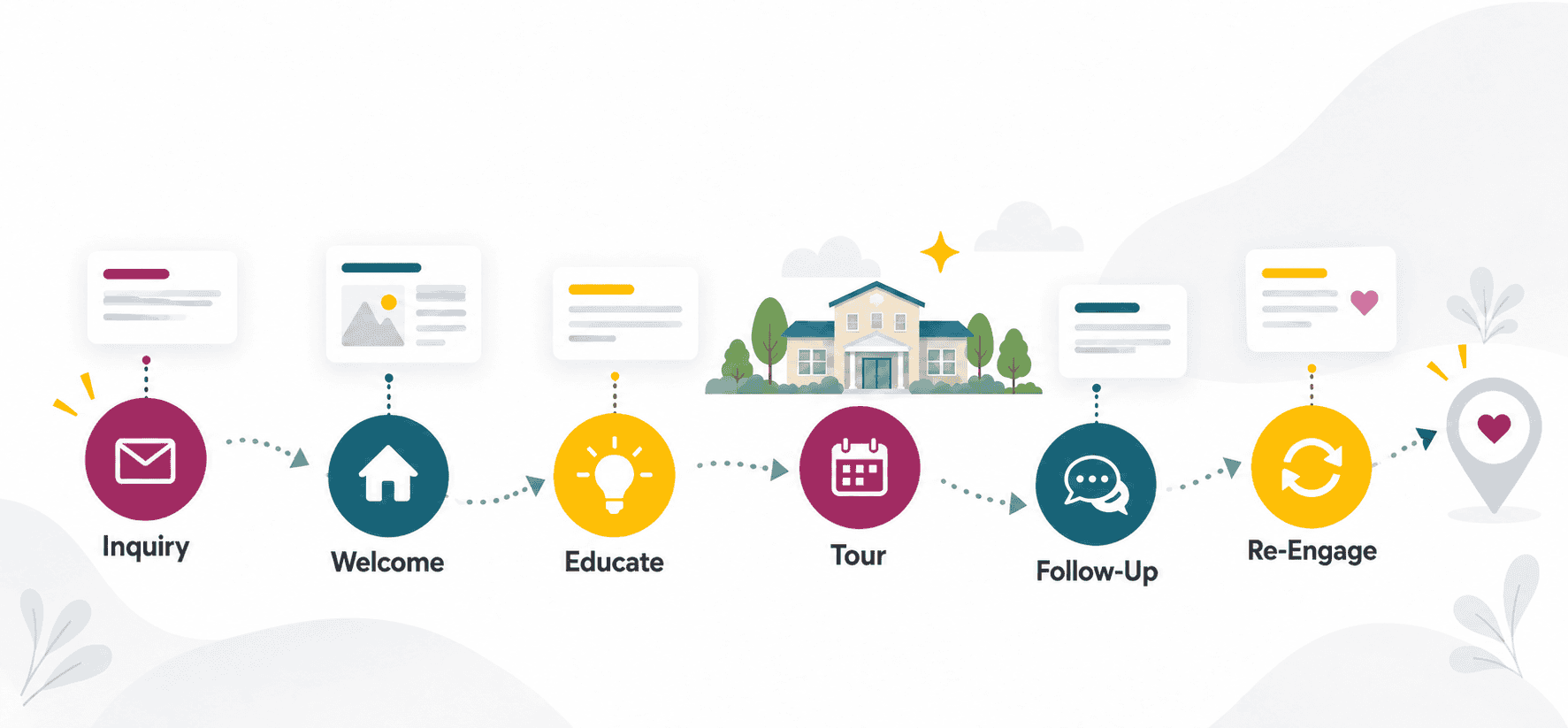
New inquiry → Welcome email → Educational nurture → Tour scheduled → Post-tour follow-up → Long-term nurture or re-engagement
Other triggers could include downloading a resource, registering for an event, attending an event, clicking pricing information, viewing a particular service line, requesting a tour or becoming inactive for a certain period.
The sophistication is not the point.
Relevance is.
Senior Housing News reported in 2025 that operators were increasingly emphasizing speed, personalization and technology-assisted follow-up, with industry leaders pointing to automation and CRM technology as ways to create faster, more personalized engagement. Senior Housing News
The best automated journeys should feel less robotic, not more.
They give your sales team more opportunities to spend their time on the human conversations that require human judgment while the technology handles repeatable communication in the background.
6. Take Email Deliverability Seriously
What is email deliverability?
Email deliverability is your ability to successfully get marketing emails into a recipient’s inbox rather than having them rejected, bounced or filtered into spam.
Because the most beautifully written email in the world is not doing much for occupancy if nobody sees it.
Deliverability has become more technical in recent years.
Google now requires bulk senders sending roughly 5,000 or more messages per day to personal Gmail accounts to meet requirements including SPF, DKIM and DMARC authentication, provide one-click unsubscribe for marketing messages and maintain low spam rates. Google recommends keeping user-reported spam rates below 0.1% and avoiding rates of 0.3% or higher. Google Help
But good email deliverability practices go beyond technical configuration.
You also need a healthy database.
That means not buying lists, making it easy to unsubscribe, monitoring engagement and regularly addressing bad email addresses.
You will also want to monitor bounces.
A hard bounce generally indicates a permanent delivery problem, such as an email address that does not exist.
A soft bounce is usually temporary. The inbox might be full, the recipient’s server may be unavailable or another short-term issue may have prevented delivery.
Repeated bounces should not simply be ignored. List hygiene protects both your reporting and your sender reputation.
And yes…sending relevant email helps deliverability too.
When people actually want your messages, they are less likely to ignore them, delete them or mark them as spam.
Imagine that.
7. Measure More Than Your Open Rate
What is a good email open rate?
It depends.
Mailchimp’s broad email benchmarks report an average open rate of about 35.6% across all users, with significant differences by industry. But Mailchimp also cautions that Apple’s Mail Privacy Protection can affect the accuracy of reported open rates. Mailchimp
So while open rate can still be useful directionally, particularly when comparing similar campaigns within your own database, it should not be the finish line.
A 60% open rate sounds fantastic.
But if nobody clicks, replies, schedules a tour or takes another meaningful next step…what did that open actually accomplish?
For senior living marketers, we recommend looking deeper into metrics like click-through rate, conversions, event registrations, replies, tour requests, sales-qualified leads and ultimately movement toward deposits and move-ins.
This becomes especially important as you connect your marketing automation platform to your sales CRM.
The goal is not simply:
Did they open the email?
It is:
Did the email help move the relationship forward?
That is a much better marketing question.
And it is why attribution matters.
So…Is Email Marketing Dead?
Not even close.
In fact, broader email research continues to show significant business value from the channel. Litmus’ 2025 State of Email research found that 35% of surveyed marketing leaders reported receiving $10 to $36 in return for every $1 spent on email, while another 30% reported returns between $36 and $50.
Those numbers are not specific to senior living, but the industry-specific data tells a similar story about email’s relevance: 80% of surveyed senior living professionals were already using email marketing as a primary marketing tool.
So email is not the outdated tactic.
Outdated email marketing is the problem.
Batching every contact into one giant list.
Sending communications that ignore where someone is in their decision.
Treating an inquiry from yesterday exactly like an inquiry from last year.
Sending automated messages long after a prospect has moved into the community.
Measuring success based entirely on opens.
Those practices deserve to be left behind.
Modern email marketing should be:
- Segmented based on who the prospect is.
- Automated around meaningful moments in the customer journey.
- Personalized based on what you know about the individual.
- Helpful rather than constantly promotional.
- Measurable beyond opens and clicks.
- Connected to your CRM, sales strategy and broader marketing ecosystem.
When those pieces work together, automation does not remove the human side of senior living marketing.
It creates more room for it.
What Does Good Senior Living Email Automation Actually Look Like?
The technology itself is not the strategy.
A sophisticated marketing automation platform filled with bad workflows will simply help you send bad marketing faster.
Start with the customer journey.
→ What happens immediately after someone submits an inquiry?
→ What does someone need after they tour?
→ What happens when a highly engaged prospect suddenly stops responding?
→ What happens after an event?
→ What happens to the person who is interested but tells sales they are “not ready yet”?
→ What happens when someone changes from an independent living prospect to assisted living?
Then decide where automation can support those moments.
For example, a new inquiry may receive an immediate welcome email with useful next steps. Over the following days, educational content can help answer common questions. A tour can trigger a different series focused on the next stage of the decision. If the prospect goes quiet, they can transition into longer-term nurture instead of falling out of the funnel entirely.
That is very different from simply setting up six emails and sending them 10 days apart.
One is an email drip.
The other is a strategy.
And we have seen that strategy translate into real senior living outcomes.
At The Gatesworth, Smart Girl Digital helped implement stage-based automation as part of a larger digital strategy. Since marketing automation launched in January 2024, the community reported a net gain of 40 units and reached 99% occupancy, with 40% of move-ins originating from digital marketing channels.Read more on that case study here.
That is the opportunity.
Not more email.
Smarter communication, delivered at the moments that matter.
Ready to Make Your Email Marketing Work Smarter?
Email is only one part of a strong marketing automation strategy.
The real magic happens when your website, CRM, marketing automation platform, content and sales process work together to create one connected customer journey.
If your current email campaigns feel disconnected, too manual or harder to measure than they should be, we can help you identify where automation could make the biggest impact.
Let’s talk about what’s working, what’s getting in the way and where your marketing automation strategy could work smarter.
Not quite ready to talk? If you’re still evaluating your tech stack, start with our guide to choosing the right marketing automation platform for your senior living community.